info@abbasimigration.com
 +61418841225

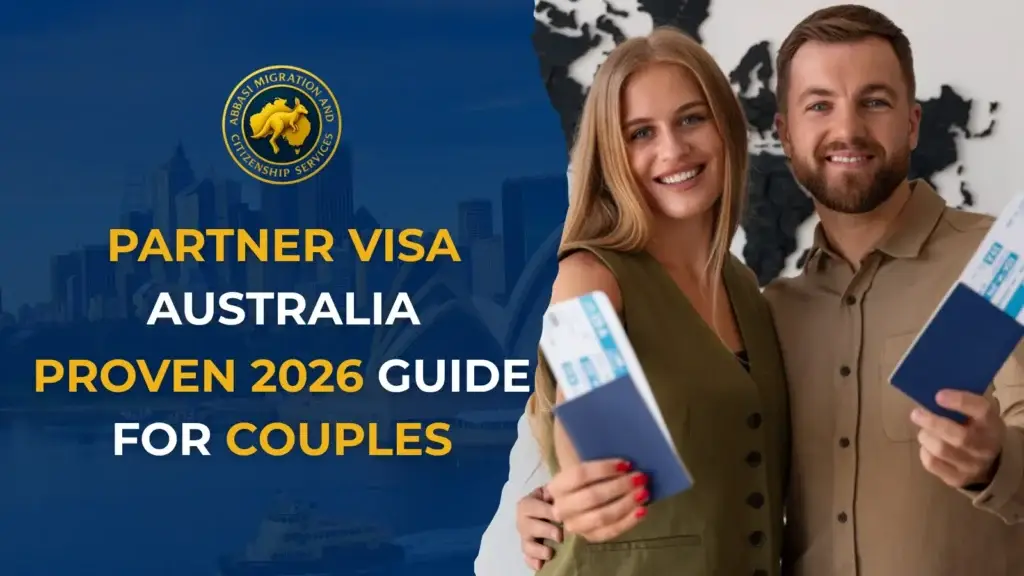
The partner visa Australia allows spouses and de facto partners of Australian citizens, permanent residents, or eligible New Zealand citizens to live permanently in Australia. There are two pathways the onshore 820/801 for applicants already in Australia, and the offshore 309/100 for applicants outside Australia. Both begin with a temporary visa and progress to permanent residency after approximately two years.
This is the first question to answer before anything else. Get it wrong and your application is invalid from the start.
You must be in Australia when you lodge the Subclass 820 (temporary onshore partner visa) and when it is granted. If you leave Australia while your 820 application is being processed, you will receive a Bridging Visa B before you go, or your application may be affected.
You must be outside Australia when you lodge the Subclass 309 (temporary offshore partner visa). If you are currently in Australia on another visa a student visa, visitor visa, or working holiday visa you cannot lodge the 309 while here. You must depart first.
| Feature | Onshore — 820/801 | Offshore — 309/100 |
|---|---|---|
| Where you apply | Inside Australia | Outside Australia |
| Temporary visa | Subclass 820 | Subclass 309 |
| Permanent visa | Subclass 801 | Subclass 100 |
| Bridging visa while waiting | Yes Bridging Visa A | No you must remain offshore or hold another visa |
| Work rights while waiting | Yes unrestricted | Depends on current visa held |
| Time to permanent | Approximately 2 years | Approximately 2 years |
Both pathways cover married couples and de facto partners. Both cover same-sex relationships. Neither requires you to have lived in Australia before applying.
Your sponsor the person who lodges the sponsorship application with the Department of Home Affairs must be one of the following:
Your sponsor must be aged 18 or over. They must also meet character requirements a criminal history does not automatically disqualify a sponsor, but serious offences, particularly involving violence or children, are assessed very carefully by the Department.
One important rule that catches people out: a person can only sponsor a partner visa applicant twice in their lifetime. Furthermore, if less than 5 years have passed since a previous partner visa sponsorship, special approval is required. This rule exists to prevent sponsorship abuse but it also affects genuine couples where one partner has been through a previous relationship.
This is the heart of every partner visa Australia application. The Department of Home Affairs doesn’t just take your word for it that your relationship is genuine. They assess four specific areas of evidence. Every applicant needs to address all four.
Evidence of shared financial arrangements. This includes joint bank accounts, shared expenses, property owned together, and one partner financially supporting the other where applicable. Bills, mortgage statements, and bank records all work here.
Proof you live together or have a reasonable explanation for why you don’t. Lease agreements, utility bills with both names, mail addressed to the same address, and statutory declarations from people who have visited your shared home all count.
Evidence that people in your life know you as a couple. Statements from friends and family, photographs together at events, shared social media presence, and evidence of attending occasions as a couple all support this area.
Documentation that shows a long-term future together. This includes future plans a mortgage, travel bookings, children, or business arrangements. Written correspondence like messages or emails can also demonstrate emotional connection and exclusivity.
One practical note: statutory declarations from friends and family matter more than most people realise. A well-written statutory declaration from someone who has known you both as a couple carries real weight. Don’t treat them as an afterthought.
De facto applicants — additional requirement: If you are not married, you must show you have been in a genuine de facto relationship for at least 12 months before applying. The 12-month requirement can be waived in limited circumstances — for example, if you have a child together, or where compelling reasons exist.
The government visa application fee applies to both the 820/801 and 309/100 pathways. As at 2026, the fees are:
| Applicant | Fee (AUD) |
|---|---|
| Main applicant | $9,365 |
| Additional applicant over 18 | $4,685 |
| Additional applicant under 18 | $2,345 |
These are government fees only. On top of this, budget for:
The partner visa is one of the most expensive visa categories in the Australian system. The fee is paid upfront at lodgment — it is non-refundable even if the visa is refused. This is another reason getting the application right the first time genuinely matters.
Processing times vary significantly depending on the visa type, the completeness of your application, and the Department’s current workload. Based on current Department of Home Affairs data:
| Visa | 75% of applications | 90% of applications |
|---|---|---|
| Subclass 820 (onshore temporary) | 14 months | 24 months |
| Subclass 309 (offshore temporary) | 17 months | 26 months |
| Subclass 801 (onshore permanent) | 20 months | 30 months |
| Subclass 100 (offshore permanent) | 20 months | 30 months |
These are long waits. However, while you’re waiting for the 820, you hold a Bridging Visa A which gives you full work and study rights in Australia. For the 309 offshore pathway, you remain on your current visa while the application is processed.
An incomplete application will sit in the queue longer. Additional information requests from the Department add months. The best way to speed up processing is to submit a complete, accurate, well-organised application the first time.
Many couples applying are not married — and that’s completely fine. The Department treats married and de facto relationships equally. However, there are two specific things de facto applicants need to be aware of.
The 12-month requirement. You must show you have been in a genuine de facto relationship — living together, committed, exclusive — for at least 12 months before the date you apply. Evidence of the relationship going back 12 months or more is essential. Recent evidence alone is not enough.
Statutory declarations carry extra weight. Because de facto couples often have less formal documentation than married couples, personal statements from people who know your relationship well help bridge the gap. These need to be specific and detailed — not vague character references.
Lodging after your visa expires. If your current visa expires before you lodge the 820, you lose the automatic Bridging Visa A protection. Lodge before it expires — always.
Thin relationship evidence. A handful of photos and one bank statement is not enough. The Department expects evidence across all four relationship areas, spanning the full period of your relationship. Gaps in evidence need explanation.
Incomplete police clearances. You need clearances from every country where you’ve lived for 12 months or more in the past 10 years. Many people forget countries they lived in briefly during study or earlier career stages. Missing one delays the application significantly.
Not addressing the 12-month de facto requirement. Submitting strong recent evidence but no historical evidence is one of the most common reasons de facto applications run into problems. Show the relationship from the beginning — not just from when you decided to apply.
Separating during processing. If the relationship ends before the temporary partner visa is granted, the application is typically refused. If the relationship ends after the temporary visa is granted but before the permanent visa is decided, contact a migration agent immediately — there are limited provisions that may apply.
Partner visa applications are personal, high-stakes, and take years to resolve. A refusal doesn’t just cost you the application fee — it can separate you from the person you love for years while you deal with appeals or rebuilding an application.
Touseef Abbasi (MARN: 2518930) at Abbasi Migration has guided couples through both the 820/801 and 309/100 pathways — including complex cases involving previous visa issues, de facto relationships with limited documentation, and situations where sponsors have prior sponsorship history.
What Abbasi Migration offers every partner visa client:
📍 Melbourne Office: Office 3669, Ground Floor, 470 St Kilda Road, Melbourne VIC 3004
📍 Wollert Office: 11 Farmley Way, Wollert VIC 3750
📞 Phone/WhatsApp: +61 418 841 225
📧 Email: info@abbasimigration.com
The Subclass 820 is for applicants who are already in Australia you apply from inside the country and remain here while it processes. The Subclass 309 is for applicants who are outside Australia. Both lead to permanent residency after approximately 2 years.
The government application fee is AUD $9,365 for the main applicant, AUD $4,685 for additional applicants over 18, and AUD $2,345 for children under 18. This fee is the same for both the 820/801 and 309/100 pathways and is non-refundable.
The temporary stage (820 or 309) typically takes 14 to 26 months for most applicants. The permanent stage (801 or 100) takes a further 6 to 12 months on average after the 2-year relationship period is met. Complete, well-documented applications process faster.
Yes. De facto couples are treated the same as married couples. However, de facto applicants must show the relationship has been genuine and continuing for at least 12 months before the application date, supported by evidence across all four relationship assessment areas.
Yes. if you lodge the Subclass 820 onshore visa, you receive a Bridging Visa A which includes unrestricted work and study rights. The 309 offshore visa does not include a Bridging Visa A — you remain on whatever visa you currently hold while waiting offshore.
If the relationship ends before the temporary visa is granted, the application is typically refused. If it ends after the temporary visa grant, specific provisions may apply including family violence provisions. Contact a registered migration agent immediately if this happens.
Yes. Australia’s partner visa applies equally to same-sex and opposite-sex couples, both married and de facto. The Department of Home Affairs assesses all relationships using the same four criteria regardless of gender or sexual orientation.

We provide a comprehensive range of visa services tailored to meet the needs of individuals from all nationalities seeking to travel, study, work, family or settle in Australia.
Quick Links
Copyright © 2026 All Rights Reserved