info@abbasimigration.com
 +61418841225

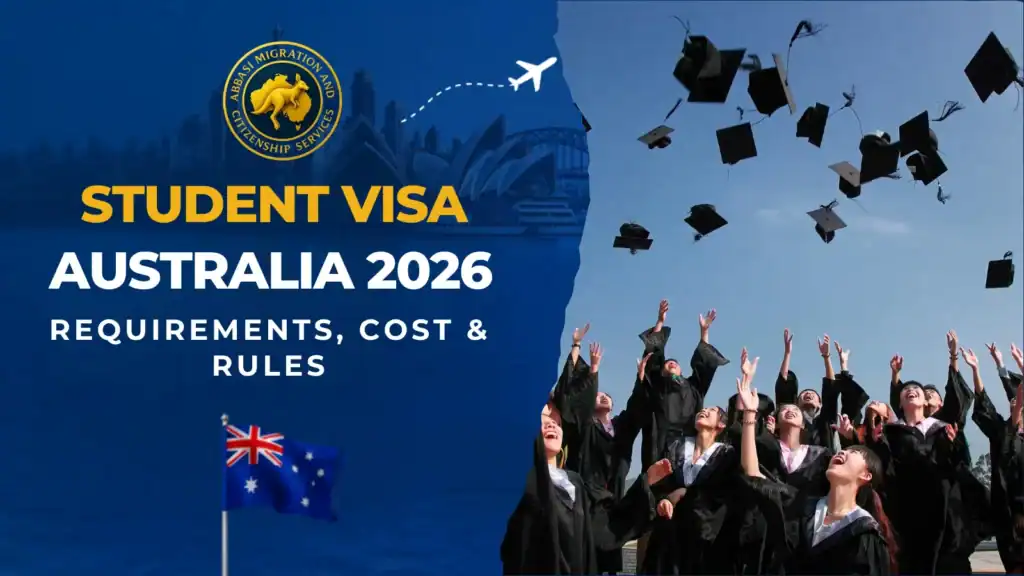
If you are planning to study in Australia, the Student Visa Australia subclass 500 is the main visa pathway for international students. It allows eligible students to study a registered course, travel in and out of Australia while the visa is valid, and work subject to the visa’s work conditions. The rules have changed significantly in recent years, so information written several years ago may no longer accurately describe the current application process.
For 2026, applicants should pay particular attention to the Genuine Student requirement, financial capacity, English evidence, Confirmation of Enrolment CoE , Overseas Student Health Cover OSHC , visa fees and offshore processing priorities. The Australian Government also increased the Student visa application charge from AUD 2,000 to AUD 2,500 from 1 July 2026 for most primary applicants.
This guide explains the key Student Visa Australia requirements, processing time, working hours, age considerations, courses, costs, documents and important 2026 rules, including information relevant to students from Pakistan.
The Student Visa Australia subclass 500 is designed for people who want to undertake an eligible course of study in Australia. Applicants can apply online either inside or outside Australia, although additional rules apply to people applying while already in Australia. A valid Confirmation of Enrolment CoE is required when the Department makes its decision, and students generally need appropriate OSHC unless an exemption applies.
The visa can cover a wide range of education sectors, including schools, English-language programs, vocational education and training, higher education and postgraduate research. Your course and education provider should be selected carefully because the course must be registered for international students through CRICOS.
The basic student visa Australia requirements depend on your personal circumstances and proposed course. The Department requires applicants to meet the relevant eligibility criteria and provide the documents identified for their application.
Common requirements include:
The Department recommends using its Document Checklist Tool because the evidence required can differ according to nationality, education sector and individual circumstances. If English or financial evidence appears on your checklist, it must be attached before submission or the application may be refused.
One of the most important Australian student visa new rules is the Genuine Student GS requirement. It applies to Student visa applications lodged from 23 March 2024 onward.
The GS assessment focuses on whether the applicant genuinely intends to study in Australia and understands that study is the primary reason for applying for the visa. The Department considers circumstances such as family and community ties, employment and economic circumstances, immigration history and the reasons for choosing the proposed course and education provider.
Applicants are asked questions about their current circumstances, why they want to study the particular course in Australia, why they selected the provider and how completing the course will benefit them. The Department’s Document Checklist information states that these responses must be written in English, with a maximum of 150 words for each relevant question.
This means your course choice should make sense when viewed against your previous education and employment history. A student does not need to prove that they will never seek another Australian visa in the future; the Department specifically recognises that genuine students may later pursue other pathways if eligible.
There is no general maximum age limit of 35 years for the Student Visa Australia subclass 500. The Department’s published eligibility criteria state that applicants must be at least 6 years old, with specific age rules applying to school students.
This is important because searches for “student visa Australia age limit 35 years” can create confusion. Being over 35 does not automatically prevent an adult from applying for a Student visa. However, age can be relevant to the overall assessment of an application, particularly when the applicant’s previous study, employment history, proposed course and future plans need to be explained under the Genuine Student requirement.
For older applicants, the focus should therefore be on building a logical and well-supported application rather than assuming there is an automatic age bar.
The Student visa can cover many types of eligible study, provided the course and provider meet the relevant requirements.
Potential Student Visa Australia courses include:
Your education provider must be appropriately registered, and the course should support a credible study plan. If you package multiple courses, the Department’s checklist requires you to identify the provider offering the principal or final course.
The Student Visa Australia price 2026 changed on 1 July 2026. The Australian Government increased the standard primary applicant Student visa application charge from AUD 2,000 to AUD 2,500.
For most applicants, the current 2026 charge can be summarised as follows:
| Applicant | 2026 Application Charge |
|---|---|
| Primary Student visa applicant | AUD 2,500 |
| Additional applicant aged 18 or over | AUD 1,530 |
| Additional applicant under 18 | AUD 500 |
The legislation also provides different concessional arrangements for eligible Pacific Island and Timor-Leste applicants, ASEAN passport holders and certain ELICOS and Non-Award applicants.
Remember that the visa application charge is only one part of the overall cost of studying in Australia. You may also need to budget for tuition, OSHC, health examinations, biometrics where applicable, flights, accommodation and living expenses.
The Department states that visa costs can change and that the applicable charge depends on when the application is received.
Applicants may need to demonstrate that they have sufficient funds to support themselves and relevant family members during their stay. Financial capacity can be particularly important for applicants from countries where the Department requires this evidence.
The commonly published living-cost benchmark for a primary student is AUD 29,710 for 12 months, with additional amounts potentially applying for accompanying family members and school-age children. Applicants should check the current Department requirements and their individual Document Checklist rather than relying solely on a generic figure.
Financial evidence can potentially include eligible deposits, loans, scholarships or financial sponsorship, depending on the applicable rules. A bank statement for a Student visa Australia should be genuine, traceable and consistent with the overall financial circumstances described in the application.
A sudden unexplained deposit can raise questions. If a family member is funding your education, the relationship, source of funds and ability to support the proposed study should be clearly documented.
The exact Student Visa Australia document checklist depends on the applicant and the course. The Department’s online checklist is therefore more useful than copying a generic list from another website.
Common documents may include:
| Document | Purpose |
|---|---|
| Passport | Identity and travel document |
| CoE | Evidence of enrolment |
| OSHC evidence | Health insurance requirement |
| English evidence | Where required |
| Financial evidence | Demonstrates financial capacity where required |
| GS information | Explains genuine study intentions |
| Academic records | Supports education history |
| Employment evidence | Relevant to circumstances and GS assessment |
| Health documents | Where requested |
| Character documents | Where requested |
The Student Visa Australia processing time is not guaranteed and can vary according to the applicant’s circumstances, the completeness of the application and the applicable processing priority.
The Department’s current processing-time page shows a 21-day figure for the Student visa category for July 2026, but this is a guide based on recently decided applications rather than a promise that every application will be decided within 21 days.
For offshore applications, processing is also affected by the Government’s student visa processing priorities. Under Ministerial Direction 115 MD115 , the priority of an offshore application is determined by the education provider associated with the main CoE and its progress toward its indicative allocation.
Applications can take longer if documents are missing, information needs verification or the Department requests additional evidence. Applicants should therefore lodge a complete application well before their course commencement date.
One of the most searched questions is “How many hours can a student work in Australia?”
A Student visa holder can generally work up to 48 hours per fortnight while their course is in session. A fortnight means a 14-day period beginning on a Monday.
There are important exceptions. For example, students undertaking a Master’s by Research or doctoral degree may have different work rights once their course has commenced. Mandatory work experience that forms part of the registered course can also be treated differently from ordinary employment.
Students should check their actual visa conditions through VEVO and should not exceed their permitted hours. Working beyond the permitted limit can result in a breach of visa conditions.
For applicants searching “Student Visa Australia for Pakistani”, the basic visa framework is the same as for other international students, but the evidence required can vary according to individual circumstances and the Department’s document checklist.
Pakistani applicants should pay particular attention to:
If there is a substantial study gap or the proposed course is significantly different from previous education, the applicant should be prepared to explain the circumstances clearly. The GS assessment specifically considers the applicant’s circumstances and reasons for choosing the proposed course and provider.
English requirements can apply to Student visa applicants, although exemptions and evidence requirements depend on the applicant’s circumstances.
Australia changed the list of approved English tests on 7 August 2025. The Department states that applicants must check the relevant visa requirements to determine which test, score and evidence are applicable. Tests taken entirely online or at home are not accepted as evidence for Australian visa purposes in the circumstances described by the Department.
Do not rely on an old IELTS or PTE table without checking whether it applies to the date and visa application you are preparing.
A Student visa applicant may be able to include eligible family members, such as a partner or dependent child, subject to the applicable requirements. The Department defines a Student visa family member as the applicant’s partner or an unmarried dependent child who has not turned 18.
Family members must meet relevant health, character and visa requirements. Additional applicant charges apply, and accompanying family members can also affect the financial capacity evidence required.
If a child is already 18, or will turn 18 before the Student visa is finalised, they generally cannot simply remain included as a dependent child under the Student visa application and may need to consider their own visa pathway.
Several developments are particularly relevant to students in 2026. The Student visa application charge increased to AUD 2,500 for most primary applicants from 1 July 2026, while concessional settings continue for specified groups.
The Genuine Student requirement continues to be a central part of the assessment, replacing the former Genuine Temporary Entrant framework for applications lodged from March 2024.
Offshore applications are also processed according to the current Ministerial Direction 115 priority framework, which considers the education provider connected to the main CoE and its indicative allocation position.
Students should also remember that the 48-hour-per-fortnight work limitation remains important for most students while their course is in session.
The basic process starts with choosing an eligible course and education provider and receiving your Confirmation of Enrolment. You then prepare your identity, English, financial, health, character and Genuine Student evidence according to your individual checklist.
The application is lodged online through the Department’s system. After submitting, you may be asked for additional information, health examinations or other evidence. The Department advises applicants to check their application carefully before submission because missing or incorrect information can delay processing.
A strong application is not simply a large collection of documents. The information should tell a consistent story: your education background, proposed course, reasons for choosing Australia and provider, financial circumstances and future plans should make sense together.
A Student visa and Tourist visa Australia serve different purposes. A Visitor visa is designed for eligible temporary visits such as tourism or visiting family, whereas the Student visa subclass 500 is designed for eligible study in Australia.
You should not choose a visitor visa simply because you want to enter Australia and then begin a substantial course of study. The correct visa depends on the purpose of your stay and the activities you intend to undertake.
If your primary purpose is education, you should investigate the Student visa requirements and the course/provider requirements before making travel arrangements.
Choosing the right course and preparing a Student visa application can involve several moving parts, from Genuine Student requirements and financial evidence to English requirements, CoE documents and visa conditions.
Abbasi Migration & Citizenship Services provides Australian migration assistance to students who want to understand their Student visa options and prepare their applications according to their individual circumstances. Assistance can include reviewing supporting documents, explaining visa requirements, identifying potential issues and helping applicants understand the application process.
For students from Pakistan and other countries, professional guidance can be particularly useful when there are study gaps, changes in career direction, previous visa refusals or complex family circumstances.
Important: Visa decisions are made by the Australian Department of Home Affairs. No migration agent can guarantee a visa grant or a specific processing time.
The Student Visa Australia subclass 500 remains the main pathway for international students who want to undertake eligible study in Australia. In 2026, applicants need to pay close attention to the Genuine Student requirement, financial capacity, English evidence, OSHC, CoE, visa fees and processing priorities.
The standard Student visa application charge for most primary applicants is now AUD 2,500 from 1 July 2026, while the general work limit remains 48 hours per fortnight when the course is in session. The Department’s July 2026 processing-time figure for the Student visa category was 21 days, but applicants should treat this as a guide rather than a guaranteed decision period.
There is also no general maximum age of 35 years for the Student visa. Instead, adult applicants should focus on demonstrating that their proposed study is credible and satisfies the Genuine Student assessment.
If you are planning to study in Australia, check the latest Department of Home Affairs requirements before lodging your application, because visa charges, processing priorities and documentary requirements can change.
📍 Melbourne Office: Office 3669, Ground Floor, 470 St Kilda Road, Melbourne VIC 3004
📍 Wollert Office: 11 Farmley Way, Wollert VIC 3750
📞 Phone/WhatsApp: +61 418 841 225
📧 Email: info@abbasimigration.com
Pakistani applicants can apply for the Student visa subclass 500 if they meet the applicable requirements. There is no separate general Student visa category exclusively for Pakistani citizens; applications are assessed according to the relevant visa rules and individual circumstances.
Important current rules include the Genuine Student requirement, the 48-hour-per-fortnight work limit for most students while courses are in session, updated offshore processing priorities and the Student visa fee increase that took effect on 1 July 2026.
The Tourist Visa Australia generally refers to Visitor Visa Subclass 600, a temporary visa for tourism, family visits, and certain short-term business activities. Depending on the circumstances and stream, a visitor may receive a stay period of 3, 6, or 12 months.
According to the supplied 2026 figures, the offshore Tourist Stream costs AUD 250, while the onshore Tourist Stream costs AUD 630. The Business Visitor and Sponsored Family streams are listed at AUD 415 each. Government charges are non-refundable.
The supplied July 2026 figures state that 75% of offshore Tourist Stream applications are processed within approximately 20–29 days and 90% within 33 days. Processing can take longer where additional checks or information are required.
No. The tourist visa doesn’t permit employment or paid work in Australia. Working while holding a visitor visa can lead to serious immigration consequences.
Yes. Pakistani passport holders can apply for Visitor Visa Subclass 600. The supplied guide states that Pakistani passport holders aren’t eligible for the ETA or eVisitor, making Subclass 600 the relevant tourist visa option.
Important documents can include your passport, six months of bank statements, employment or business evidence, evidence of home-country ties, travel plans, health insurance, and a clear Genuine Visitor statement. Family visit applications may also require an invitation and evidence of the Australian host’s status.
A No Further Stay condition, such as Condition 8503, can prevent a visitor from applying for certain further visas while in Australia. Applicants should check their current visa conditions before attempting an onshore application.
You can’t automatically extend a Subclass 600 visa. Depending on your circumstances, you may be able to apply for another visa from inside Australia, but a No Further Stay condition can prevent this. Always check the conditions of your current visa before lodging another application.
Visitor visa holders generally don’t have access to Medicare except in limited circumstances involving reciprocal healthcare arrangements. Appropriate private health insurance is therefore strongly recommended, and applicants should follow any specific Department requirements that apply to their case.
Common problems include weak evidence of genuine temporary intent, suspicious or unexplained finances, undisclosed immigration history, vague travel plans, No Further Stay issues, and inconsistent or missing documents.

We provide a comprehensive range of visa services tailored to meet the needs of individuals from all nationalities seeking to travel, study, work, family or settle in Australia.
Quick Links
Copyright © 2026 All Rights Reserved